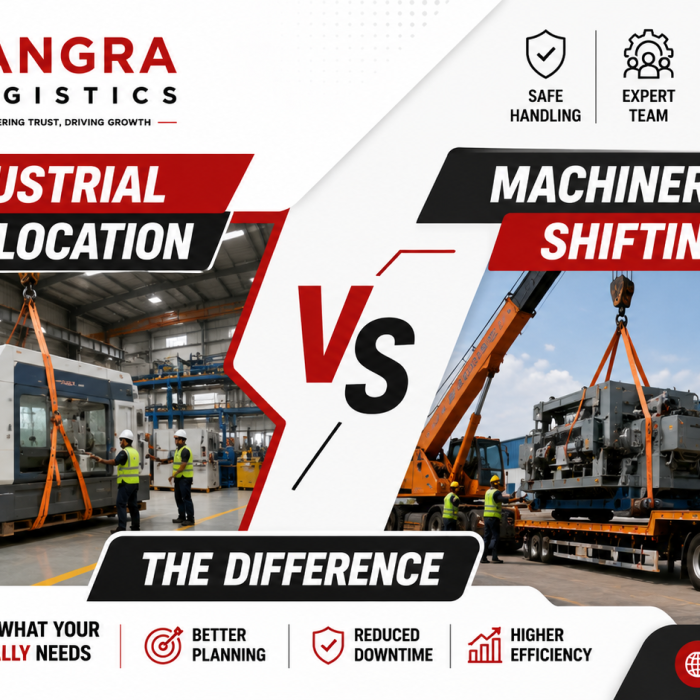
Moving a machine from one end of a warehouse to the other sounds like the easy part of a plant relocation. It isn’t. Outside, you’ve got a truck, a crane, and open space to work with. Inside a warehouse, you’ve got narrow aisles, racking on both sides, a concrete floor that might not be rated for the load you’re rolling across it, and usually zero room for error if something starts to tip. More machines get damaged during a 40-meter internal shift than most factory owners expect, simply because everyone assumes “it’s not going far, so it’s not a big job.”
This guide is for anyone repositioning machinery inside a warehouse or factory floor — whether you’re rearranging a production line, making space for new equipment, or shifting machines during a plant reorganization. It covers what actually needs checking before you move anything, the equipment that makes internal moves safe, the common mistakes that cause the most damage, and when it’s worth calling in a team that does this for a living instead of assigning it to whoever’s free that day.
Why Moving Machinery Inside a Warehouse Is Its Own Challenge
Floor load capacity isn’t the same everywhere. Warehouse floors are built for distributed weight — pallets and racking spread the load evenly. A heavy machine rolling on a small number of wheels or skids concentrates that same weight onto a tiny footprint, and older or lower-grade concrete can crack or sink under that kind of point load.
Aisles are built for forklifts, not machinery. Standard warehouse aisles are sized for pallet movement, not for a 3-meter-wide machine with an awkward center of gravity. Every turn needs to be measured in advance, not judged by eye as you go.
Racking and other equipment are inches away. Outside, a small miscalculation means a wider turn. Inside a warehouse, the same miscalculation means a machine clipping a rack upright, which can compromise the entire racking structure above it — not just the machine.
Overhead clearance matters as much as floor space. Sprinkler systems, low beams, and racking crossbars are all real obstacles that a taller machine or a raised lifting method can hit if nobody’s checked the height in advance.
You’re usually working around ongoing operations. Unlike a full plant shutdown for an external move, internal repositioning often happens while the rest of the warehouse is still running — other staff, other equipment, and other machines are all moving around the same space at the same time.
Before You Move Anything: The Pre-Move Checklist
1. Check the floor load rating. Find out what your warehouse floor is actually rated for, especially along the exact path the machine will travel. If you don’t have this documented, it’s worth confirming before moving anything over a few hundred kilograms.
2. Measure the full path, not just the start and end points. Walk the entire route with a tape measure — every turn, every doorway, every point where the aisle narrows. A machine that fits through the main aisle can still get stuck at a single narrow turn near the loading dock.
3. Check overhead clearance along the same path. Note the height of sprinkler heads, low beams, and any racking crossbars the machine or lifting equipment might pass under.
4. Know the machine’s actual weight and center of gravity. Don’t estimate. A wrong guess here leads to choosing the wrong moving equipment, which is exactly where things go wrong.
5. Plan the move during low-activity hours if operations are ongoing. Even a short internal move creates a temporary hazard zone — plan it for a quieter shift if the warehouse can’t be fully cleared.
6. Decide if any part of the machine needs to come off first. Removing panels, guards, or attachments can reduce width, height, or weight enough to make the move significantly safer and easier.
Equipment Used for Moving Machinery Inside a Warehouse
Machine skates and dollies — Low-profile, wheeled platforms placed under the machine’s legs or base, used for moving heavy equipment across smooth warehouse floors with minimal effort and full directional control.
Roller skids — A set of steel rollers under a load-bearing beam, useful for straight-line moves over shorter distances where turning isn’t needed.
Hydraulic toe jacks — Used to lift one section of a machine just enough to slide a skate or roller underneath, without needing a full crane lift.
Rigging gantries — A portable overhead lifting frame, useful when a machine needs to be lifted clear off the ground temporarily, such as when repositioning it onto a new foundation or base.
Forklifts (with the right capacity and attachments) — Suitable for machines with a stable base and known weight limits, but only when the forklift’s rated capacity clearly exceeds the machine’s weight, including a safety margin.
Air skates (air-powered dollies) — Used for very heavy or delicate machinery, these float the load on a thin cushion of air, allowing it to be moved in any direction with very little force and almost no vibration — useful for precision equipment that can’t handle jarring movement.
The right choice depends on the machine’s weight, the floor condition, and the path available — there’s no single tool that works for every internal move.
Step-by-Step: How to Move Machinery Inside a Warehouse Safely
1. Confirm the pre-move checklist is complete. Floor rating, path measurements, overhead clearance, and machine weight should all be confirmed before any equipment is brought in.
2. Clear and mark the route. Remove any obstacles from the path and mark the area as a temporary hazard zone if other staff will be working nearby during the move.
3. Dismantle any parts that increase width, height, or weight unnecessarily. This step should happen before lifting begins, not partway through.
4. Lift and set the machine onto skates, rollers, or an air skate system. This is done using toe jacks or a gantry, depending on the machine’s weight and design.
5. Move slowly and in a straight line where possible. Turns should be planned and controlled, not improvised — especially in tight aisles.
6. Use a spotter at every turn and doorway. One person guiding and watching for clearance issues prevents the most common cause of damage: someone assuming there’s enough space when there isn’t.
7. Position the machine at its new location and lower it into place. This often needs the same lifting equipment used at the start, in reverse.
8. Reassemble any dismantled parts and check alignment. For production machinery especially, alignment to the new position matters for the equipment to run correctly.
Common Mistakes That Damage Machinery During Internal Moves
- Assuming a short distance means low risk. A 20-meter move causes just as much damage as a 200-meter one if the floor, path, or equipment choice is wrong.
- Not checking floor load rating before rolling a heavy machine across it. This is one of the most overlooked steps, and floor damage is expensive and disruptive to repair.
- Using a forklift rated too close to the machine’s actual weight. A forklift working near its maximum rated capacity has very little safety margin left for uneven weight distribution.
- Skipping the dry run. Walking the empty route with the actual moving equipment before the machine is on it catches problems — a rack that sticks out slightly further than expected, a door that doesn’t open fully — before they become a mid-move crisis.
- Not using a spotter at turns. This is where machines clip racking, doorframes, or other equipment most often.
- Rushing because operations are still running around the move. Pressure to finish quickly is exactly when shortcuts happen, and shortcuts are where damage happens.
Cost of Professional Internal Machinery Moving
| Factor | How It Affects Cost |
|---|---|
| Machine weight | Heavier machines need stronger equipment (air skates, gantries) and more manpower |
| Distance inside the warehouse | Longer internal distances take more time, even without transport involved |
| Dismantling requirement | More components to remove and reassemble adds labour hours |
| Floor condition and load rating | Weaker floors may need load-spreading mats or an alternate route, adding planning time |
| Access difficulty | Tight aisles, sharp turns, or low overhead clearance all add complexity and time |
There’s no honest flat rate for this without seeing the machine, the floor, and the actual route. A short internal move can sometimes cost more than a longer external one if the machine is heavy and the path is difficult.
When to Call in a Professional Team
Moving one small, light piece of equipment a short distance with a pallet jack is usually fine to handle in-house. Anything heavier, anything requiring lifting off the ground, or anything moving through a tight or obstacle-filled path is a different level of risk. The cost of hiring trained riggers is almost always lower than the cost of a damaged machine, a cracked warehouse floor, or a production line down for repairs.
If your internal machinery move is part of a larger plant reorganization or relocation, our industrial shifting services team handles both the internal repositioning and any external transport needed, as one coordinated job — floor assessment, the right lifting and moving equipment for your specific machines, and reassembly once everything is in its new position.
Frequently Asked Questions
Do I need to check the floor load rating even for a short move? Yes. Distance doesn’t reduce the point load a heavy machine puts on the floor. A short move on a weak floor can still cause cracking or sinking.
What’s the difference between skates and air skates? Skates are wheeled platforms that need to be pushed or pulled. Air skates float the load on a cushion of air, allowing very heavy or delicate machines to be moved with minimal force and almost no vibration.
Can a standard warehouse forklift move heavy machinery? Only if the forklift’s rated capacity clearly exceeds the machine’s actual weight, with a safety margin. Working close to a forklift’s maximum rating leaves little room for error.
How do I know if my machine needs to be partially dismantled before moving? If it doesn’t fit through the planned path at its current width or height, or if certain parts add unnecessary weight for a short lift, dismantling makes the move safer and easier. A site assessment will confirm exactly what’s needed.
Is it safe to move machinery while the warehouse is still operating? Yes, with proper planning. This usually means scheduling the move during lower-activity hours and marking the route as a temporary hazard zone while work is in progress.
How long does an internal machinery move usually take? This depends heavily on weight, distance, and path complexity. A straightforward move might take a few hours; one requiring dismantling and reassembly can take a full day or more.
Do you provide the moving equipment, or do we need to arrange it ourselves? We bring the equipment needed based on your machine’s weight and the warehouse layout — skates, rollers, gantries, or air skates as required.
What happens if the machine doesn’t fit through an existing aisle or doorway? This is exactly why a full route measurement happens before the move, not during it. If access is tight, we plan for partial dismantling or an alternate route in advance.
Can you handle alignment and reassembly at the new position, not just the move itself? Yes. For production machinery especially, correct alignment at the new location matters just as much as the move itself, and this is included as part of the job.
Is insurance available for machinery being moved internally? Optional transit and handling insurance is available for internal moves involving high-value machinery. We’ll explain the coverage clearly at the time of booking.
Planning an Internal Machinery Move? Start With a Site Visit
Don’t let a “short distance” fool you into skipping the planning. Send us your machine details, warehouse layout, and the distance involved, and our team will assess the floor, the path, and the right equipment before quoting — not guess over the phone. Call us or send your details on WhatsApp, and we’ll help you move it without the drama.