Moving a sofa is one kind of problem. Moving a 400 kg industrial generator, a fully assembled gym machine, or a commercial refrigeration unit is a completely different one — and treating it the same way is how equipment gets damaged, people get injured, and what looked like a straightforward relocation turns into a repair bill and a delay.
Heavy equipment moves are different from regular shifting in three specific ways. The weight requires different lifting techniques and equipment that most general movers do not carry. The size creates access problems — doorways, stairwells, elevator dimensions, vehicle ramp capacity — that need to be assessed before move day, not discovered on it. And the value means the consequences of getting any of these things wrong are expensive, sometimes irreversibly so.
This guide covers what you actually need to know before moving heavy equipment — whether that is industrial machinery from a Pune factory to a new facility in Gurgaon, gym equipment from a shutting fitness studio in Bangalore, a commercial kitchen setup from a Delhi restaurant, large agricultural equipment from a warehouse in Ludhiana, or heavy medical equipment from a clinic in Hyderabad. The principles are the same even when the equipment is not.
If you are planning a heavy equipment move and want to know what it will cost and how Jangra Logistics approaches it, call or WhatsApp us and we will get back to you the same day.
What Counts as Heavy Equipment for Moving Purposes
Not everything that is heavy qualifies as heavy equipment in the context of moving. A large wooden almirah is heavy but it is a piece of furniture — moving companies handle these every day with standard crew and technique.
Heavy equipment is a different category. It refers to items that require specialised lifting gear, reinforced vehicles, or specific disassembly and reassembly knowledge to move safely. The common categories in India include:
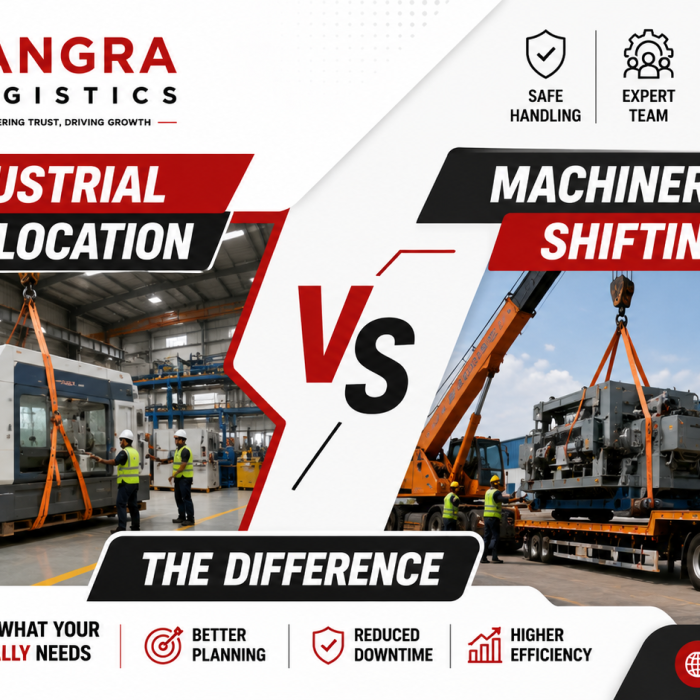
Industrial machinery — CNC machines, lathes, printing presses, injection moulding machines, compressors, generators, industrial fans, and similar production equipment. These are typically found in manufacturing units, workshops, and small factories across industrial zones in cities like Faridabad, Pune’s Pimpri-Chinchwad industrial belt, Surat’s textile manufacturing clusters, and Chennai’s auto component corridors.
Gym and fitness equipment — commercial treadmills, multi-station gym machines, cable crossover stations, leg press machines, and Smith machines. A single commercial treadmill can weigh 150–200 kg. A fully assembled multi-station can exceed 300 kg and may have components that need to be separated before any movement is possible.
Commercial kitchen equipment — industrial ovens, walk-in refrigerators, commercial dishwashers, large cooking ranges, and exhaust hoods. Restaurants, hotels, and cloud kitchens in cities like Mumbai, Delhi, and Ahmedabad move these when relocating or shutting down.
Medical and hospital equipment — X-ray machines, CT scanners, MRI units (which require specialist handling beyond standard heavy equipment moving), hospital beds, surgical tables, and large diagnostic equipment. Medical equipment adds a layer of sensitivity around calibration and regulatory requirements on top of the standard weight and access challenges.
Agricultural equipment — tractors, threshers, harvesters, and related machinery that needs to move between seasons or when a farm changes hands. Common in Haryana, Punjab, western Uttar Pradesh, and Rajasthan.
Large home appliances and luxury items — heavy marble tables, large safe boxes, grand pianos, and oversized home gym setups. These blur the line between standard household items and proper heavy equipment.
If your item is above 100 kg, requires disassembly to clear a doorway, or needs a crane or forklift to lift, you are in heavy equipment territory regardless of what category it falls into.
Why Heavy Equipment Moves Go Wrong — The Most Common Problems
Understanding where these moves typically fail is the most useful starting point, because most problems are predictable and therefore avoidable.
Access is assessed too late. The equipment is ready to move and the crew arrives, and then someone realises the doorway is 80 cm wide and the machine is 95 cm. Or the freight elevator capacity is 500 kg and the equipment plus its rigging is 650 kg. Or the delivery address in a narrow Chandni Chowk lane cannot fit a flatbed truck within 200 metres of the destination. Access problems discovered on move day are far more expensive to solve than access problems identified during a site survey the week before.
The wrong vehicle is sent. Moving a 600 kg generator in a standard tempo vehicle is not just a bad idea — it is a safety risk. Vehicles used for heavy equipment need reinforced beds, rated lashing points, and ramps or tail lifts capable of handling the load. Sending the wrong vehicle means either the job cannot be completed as planned, or it is completed unsafely.
The equipment is moved without being properly drained or secured. Industrial machinery that uses oil, hydraulic fluid, or coolant needs to be drained before transport. A machine that is moved with fluid in the lines can leak during transit, which causes damage to the machine itself, to the vehicle, and sometimes to other cargo nearby.
Disassembly is underestimated. Some equipment looks like it should be moveable in one piece and is actually not — not because it is too heavy but because of how it is bolted, wired, or connected to utilities like compressed air or three-phase electrical supply. Disconnecting these without the right knowledge can damage the equipment and complicate the reconnection process at the destination.
Recalibration is not planned for. Many categories of heavy equipment — CNC machines, medical imaging devices, industrial scales — need professional recalibration after they have been moved, even if the move went perfectly. This is not a moving company function, it is a technician function. But not planning for it means the equipment sits idle at the destination for longer than it should.
Planning a Heavy Equipment Move — What Has to Happen Before Move Day
This is where the bulk of the work actually goes. A well-executed heavy equipment move is mostly planning. The physical move itself, when planned properly, tends to be relatively uneventful.
Site survey at both ends. This is not optional for any heavy equipment move above a certain weight or complexity. The survey needs to cover door and corridor widths, floor load ratings, elevator or ramp capacity, access for the truck, proximity of parking to the loading point, and any overhead obstructions like pipes or low beams that affect rigging. Both the pickup and delivery locations need this assessment — not just one.
Equipment documentation before disassembly. Before any component is removed, photograph the full assembled machine from multiple angles. If it has a control panel, wiring loom, or calibrated settings, document these separately. This is insurance against reassembly confusion at the destination.
Utility disconnection coordination. If the equipment is connected to three-phase power, gas lines, compressed air, water inlet, or drainage — each of these needs to be disconnected by a qualified person, not by a loading crew. Arrange these disconnections in advance, not on move day. The same applies at the destination for reconnection.
Floor protection at both ends. Heavy equipment on casters or dollies tears up floor surfaces. If you are moving equipment out of a facility with a finished floor, or into one, plan how the floor will be protected during the move — hardboard sheets, rubber matting, or similar.
Weight and dimension confirmation. Get the exact weight and dimensions of the equipment from the manufacturer’s specifications, not from memory or estimation. This determines the vehicle type, the rigging equipment, and sometimes the route, since some vehicles with outsize loads require route permits on state and national highways.
Moving permits for oversized loads. In India, transporting machinery or equipment that exceeds standard vehicle dimension and weight limits on national or state highways requires a permit from the relevant state transport authority. If your equipment is large enough to qualify as an oversized load, this permit needs to be arranged before the truck leaves — not after it is stopped at a check post.
Equipment You Need for a Heavy Equipment Move
General packers and movers carry blankets, bubble wrap, and cardboard. None of these are the primary tools for a heavy equipment move. Here is what the move actually requires:
Industrial toe jacks and hydraulic jacks — for lifting equipment off the floor to position dollies underneath. Different from the floor jacks used for vehicles.
Heavy-duty skates and dollies — flat platforms on wheels rated for the load weight. Equipment sits on these for horizontal movement within a facility or loading area. Load rating matters — a dolly rated for 300 kg used under a 500 kg machine is a risk, not a solution.
Chain hoists and electric hoists — for lifting equipment vertically onto a truck bed or through a confined vertical space where a forklift cannot operate.
Forklifts — where outdoor or warehouse floor access allows. Not always available at the pickup or delivery point, but where they are, they reduce lift time significantly and are safer for very heavy single-piece equipment.
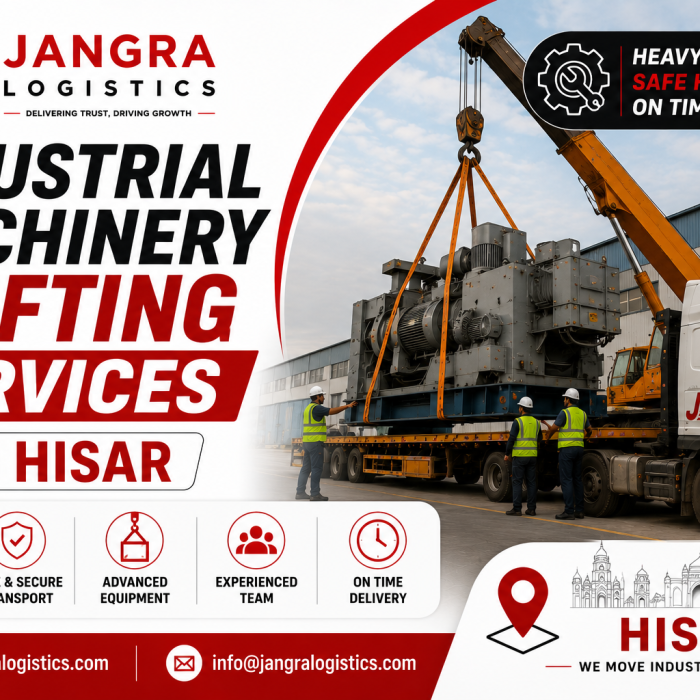
Cranes — for equipment that cannot be moved through a building’s internal access routes and needs to be lifted directly from a building opening or roof. Commercial crane hire in India is available in major cities and industrial areas.
Ratchet lashing straps — not regular rope. Rated lashing straps with specific break-strength values secure the equipment to the vehicle bed so it cannot shift during transit. Equipment that shifts in transit is both a road safety problem and a damage risk.
Reinforced flatbed or low-bed truck — standard tempos are not appropriate. The vehicle bed needs to be rated for the equipment weight, and the bed height and ramp access need to accommodate how the equipment will be loaded.
A heavy equipment moving company carries or coordinates access to most of this. If you are evaluating a quote from a mover, ask specifically which of these they own and which they hire. Companies that own their rigging equipment typically coordinate moves better than those who are hiring everything on the day.
Specific Equipment Categories — What Moves Differently
Industrial Machinery
Most production machinery needs to be moved on its base frame if it has one. Separating the machine from its base often changes the calibration and level reference that the machine was set up on, which means recalibration at the destination anyway — and it sometimes creates structural problems with the machine’s body. Where the frame and base can travel together, that is usually the right approach.
Bolts and mounting hardware that are removed during disassembly need to be bagged and labelled. A machine that arrives at its new location in Noida from a Faridabad factory with all its bolts in a single unlabelled plastic bag is reassembled much more slowly and with much more uncertainty than one where every component is documented.
Gym Equipment
Commercial gym equipment is almost always easier to move partially disassembled. Multi-station cable machines have weight stacks that can be removed and transported separately, significantly reducing the single-piece weight. Treadmill decks on commercial models are often separable from the frame.
The problem with gym equipment is that many machines have a manufacturer-specific assembly process that is not intuitive from the outside. Without the service manual or a technician who knows the machine, reassembly at a new gym in Bengaluru or Hyderabad can take longer than the move itself. Get the service documentation for any complex multi-station machine before it is taken apart.
Commercial Kitchen Equipment
Walk-in refrigeration units are some of the more complex commercial kitchen items to move because they involve refrigerant lines and electrical connections that must be handled by a certified refrigeration technician. This is a legal requirement in India, not just a practical recommendation. The refrigerant must be recovered before the unit is moved, which requires specialised equipment and certification.
Commercial ovens and cooking ranges are generally more straightforward — gas supply disconnection, careful horizontal handling during transit, and reconnection at the destination. The risk area is the internal elements of convection ovens and combi units, which can be damaged by vibration if they are not secured internally before transport.
Large Appliances — Safes, Marble Tables, Pianos
Heavy domestic items that blur into heavy equipment territory.
Safes, depending on their weight category, may need hydraulic dollies and reinforced vehicle beds the same way industrial equipment does. A 300 kg floor safe is not a furniture move even though it lives inside a home.
Marble dining tables are fragile in a way that their weight does not suggest. The stone can crack under its own weight if the slab is not supported at multiple points during transport and is not carried horizontally throughout. Vertical transport of a large marble slab is a crack risk.
Grand pianos need specific piano boards and piano dollies, and ideally a team that has moved pianos before. The mechanism inside a grand piano is not designed for vibration, and the lid, legs, and pedal lyre all need to come off before any horizontal movement. The lid hinges on many concert grands are precisely tensioned and do not respond well to amateur disassembly.
Safety Rules for Heavy Equipment Moving
These are not soft guidelines. They are the difference between a move that completes without incident and one that ends with an injury or a damaged floor or a dropped machine.
Weight ratings must be respected. Every piece of lifting equipment has a rated working load limit. Moving a machine that exceeds the rated capacity of the dolly, the hoist, or the truck bed is not a corner worth cutting. If the equipment is heavier than the capacity, get better-rated equipment.
Two people minimum on any lift above 50 kg. Manual handling of anything above this threshold without mechanical assistance is a back injury waiting to happen and is also against standard workplace safety guidelines in India under the Factories Act.
Secure before every move. The machine or equipment must be secured to the transport vehicle or dolly before any horizontal movement begins. Equipment that starts sliding on a ramp or in a truck is no longer under anyone’s control.
Clear the path completely before starting. Every person, every loose item, every other piece of equipment that is not part of the move should be out of the immediate working area. A heavy machine that tips or shifts affects everything and everyone nearby.
Brief the crew on the plan before lifting starts. Every person in the crew needs to know the sequence, the communication signals, and what to do if something goes wrong. Improvising mid-lift is dangerous.
The Cost of Moving Heavy Equipment in India — What Affects the Price
Heavy equipment moving costs vary more than standard household shifting because there are more variables. Here is what actually drives the price:
Weight and dimensions. These determine the vehicle type, the rigging equipment needed, and the crew size. A 200 kg gym machine and a 2,000 kg CNC lathe are different orders of magnitude.
Access difficulty. A ground-floor factory with direct forklift access costs less to load than a third-floor workshop with a narrow staircase. Access difficulty is the biggest variable in heavy equipment moving costs.
Distance. Local moves within the same city — say, from one MIDC zone to another in Pune, or between two industrial areas in Faridabad — cost less than intercity moves. Long-distance heavy equipment transport across state borders adds fuel, permit, and driver allowance costs.
Disassembly and reassembly requirement. Equipment that must be taken apart to move and reassembled at the destination requires more skilled labour and more time. This is charged separately from the basic transport cost in most quotes.
Permits and escorts. Oversized loads that require route permits or police escorts on state highways add administrative cost. This is not negotiable — it is a legal requirement.
Specialised equipment hire. If a crane is needed and the moving company does not own one, crane hire is charged as a pass-through cost. Get this confirmed in writing in the quote.
As a rough picture for 2025, local heavy equipment moves within the same city in India typically range from ₹8,000 to ₹40,000 depending on weight and access. Intercity moves for single heavy machines range from ₹15,000 to ₹80,000 or more for complex, long-distance jobs. These are starting points, not fixed rates — get a written quote specific to your equipment and route.
Questions to Ask Before Booking a Heavy Equipment Mover
Do you own your rigging equipment or hire it? Own is generally better for coordination and accountability.
Have you moved this type of equipment before? A gym equipment specialist may not be the right choice for a CNC machine, and vice versa.
What is your process if access at either site turns out to be a problem? The answer tells you how experienced they are.
What is included in the quote — disassembly, permits, crane hire? Get every cost in the written estimate. Nothing should appear on move day that was not in the quote.
Do you have liability coverage for equipment damage? Standard transit insurance applies to household goods. High-value industrial equipment may need its own declared-value coverage. Confirm this before signing.
Who coordinates utility disconnection? The mover should either do this or tell you exactly who should, and when it needs to happen before move day.
Frequently Asked Questions — Moving Heavy Equipment
What is considered heavy equipment for moving?
Heavy equipment in a moving context refers to items above approximately 100 kg that require specialised lifting gear, reinforced vehicles, or specific disassembly knowledge to move safely. This includes industrial machinery, commercial gym equipment, large kitchen units, medical devices, safes, and similar items.
Do I need a permit to transport heavy machinery in India?
Yes, if the load exceeds the standard vehicle dimension or weight limits permitted on state and national highways. These permits are issued by the relevant state transport authority and need to be arranged before the move. Your moving company should handle this, but confirm it is in scope before you book.
How is heavy equipment loaded onto a truck?
Depending on weight and access, loading uses hydraulic jacks, industrial dollies, chain hoists, forklifts, or cranes. The method is determined during the site survey. The equipment is then secured with rated ratchet lashing straps to prevent any movement during transit.
Can I move heavy equipment in a regular packers and movers truck?
For most heavy equipment, no. Standard tempo vehicles are not built for the weight, and do not have the rated lashing points or ramp capacity that heavy equipment loading requires. A reinforced flatbed or low-bed truck with appropriate rated capacity is needed.
How much does moving heavy equipment cost in India?
Local heavy equipment moves within the same city start from approximately ₹8,000 and go up depending on weight, access difficulty, and equipment type. Intercity moves start from around ₹15,000. Exact cost requires a site survey and a written quote specific to your equipment and route.
Does heavy equipment need to be drained before transport?
If the equipment uses oil, hydraulic fluid, coolant, or refrigerant — yes. These fluids need to be drained or recovered by a qualified person before the equipment is transported. This applies to compressors, refrigeration units, hydraulic presses, and similar machinery.
Will heavy equipment need recalibration after moving?
Many types of industrial and medical equipment require recalibration after being moved, even when the physical move goes perfectly. CNC machines, precision lathes, medical imaging equipment, and industrial scales are the most common examples. Plan for this as a separate step after delivery.
Can gym equipment be moved without disassembly?
Some pieces can, some cannot. A standalone treadmill or stationary bike can often move in one piece. A multi-station cable crossover or Smith machine almost always needs partial disassembly to clear doorways and reduce per-piece weight. The service manual for the specific machine guides this process.
How do I protect floors during a heavy equipment move?
Hardboard sheets, rubber matting, or masonite boards placed along the movement path protect finished floors from dollies and the equipment’s weight. Floor protection at both the pickup and delivery location should be planned in advance, especially in commercial spaces with polished concrete or tile floors.
How far in advance should I book a heavy equipment mover?
At minimum two weeks for a straightforward local job. For intercity moves, complex disassembly, or moves that require crane hire or permits, four to six weeks gives enough lead time for the site survey, permit application, and equipment arrangement.
Closing
Moving heavy equipment is one of those jobs where everything that goes wrong was predictable, and everything that goes right was planned. Access problems, wrong vehicle, missing permits, undrained machinery — these are not random bad luck. They are the result of not doing the site survey, not asking the right questions, not confirming what the quote actually covers.
Jangra Logistics handles heavy equipment moves across India — industrial machinery in manufacturing zones like Faridabad and Pimpri-Chinchwad, commercial kitchen setups in Mumbai and Delhi, gym equipment for fitness businesses relocating in Bengaluru and Hyderabad, and large domestic items like safes and marble furniture across residential addresses. Every job starts with a site survey and ends with a written quote that covers what the move actually needs, not a ballpark number that changes once the truck is already there.
If you have heavy equipment to move and want to know what the job actually involves and costs, call or WhatsApp Jangra Logistics today. Same-day response, honest assessment.